
Dog Training Prices in Hampton Roads, VA
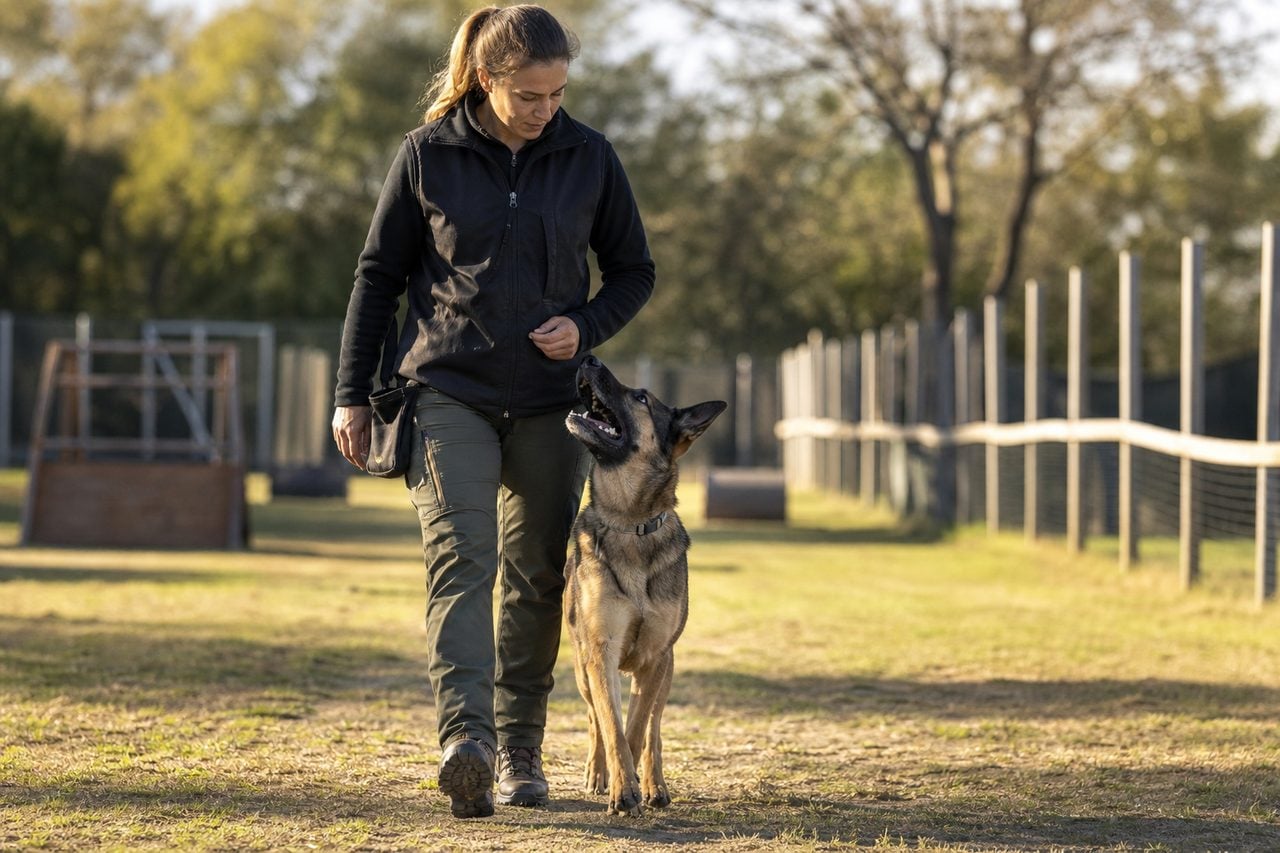
Dog training in Hampton Roads is sold in three broad shapes and the price gap between them is enormous — from a nine-week club course costing less than a tank of fuel to a residential behavior program costing thousands. Comparing them by headline price is close to meaningless, because they are not the same product. What follows is what the region’s businesses actually publish, what drives the differences, and how to work out which shape your household should be buying before you start comparing numbers.
What Dog Training Costs in Hampton Roads (2026)
In the Hampton Roads area, a private lesson typically costs $100, a group class course $180, and board and train about $992 a week. These are not national estimates: we read the prices that 36 Hampton Roads-area trainers publish on their own websites.
| Service | Typical price | Most trainers charge | Lowest to highest | Trainers |
|---|---|---|---|---|
| Private lesson, one session | $100 | $80 to $110 | $50 to $150 | 15 |
| Group class, full course | $180 | $150 to $180 | $100 to $250 | 13 |
| Board and train, per week | $992 | $875 to $1,250 | $600 to $2,000 | 18 |
| First consultation, when charged | $150 | $100 to $150 | $25 to $150 | 9 |
The price range for each service
what the middle half of trainers chargetypical (median) price
Private lessons: $50 to $150 a session
15 trainers publish a single-session price, and the middle half charge $80 to $110. Session length explains much of the spread: of the 10 trainers who state a length, 9 run about an hour and 1 run longer than an hour. Worked out per hour, the typical rate among those trainers is about $92. Behavior cases such as reactivity or aggression usually cost more than basic manners, and in-home visits more than lessons at the trainer’s facility.
Group classes: $100 to $250 for a course
13 trainers publish a course price. Courses here run 5 to 9 weeks with one class a week, so the typical $180 course works out to roughly $30 a class. Club and nonprofit classes tend to sit at the low end; small-group and specialty courses at the high end.
Board and train: $600 to $2,000 a week
18 trainers publish a board-and-train price. Programs here run 1 to 4 weeks, and the published program totals range from $950 to $4,000. Ask what follow-up lessons are included, because that is where programs differ most.
Hampton Roads compared with other areas
Typical prices in Hampton Roads next to the typical price across the 514 US areas we have read so far.
17% lower in Hampton Roads
About the same in Hampton Roads
About the same in Hampton Roads
Published prices by trainer (36 trainers)
Each price is the trainer’s own published price as read in November 2026. Prices change; confirm with the trainer.
Statewide: what dog training costs across Virginia.
Two things make this market unusual. The first is the club sector: two long-established AKC-affiliated non-profit clubs, one on each side of the water, provide most of the structured weekly group instruction in the region at prices no commercial operation can match, because they are volunteer-instructed. That is the floor of the market and it is a genuinely good product.
The second is the residential sector. Thirty of the ninety-eight listed businesses publish board-and-train, which is a high proportion driven by the deployment cycle and by two tunnels that make a weekly commitment across the water impractical. Residential work is the most expensive thing on the list and it is bought here for structural reasons rather than because households are lazy.
The three price tiers, and what sits in each
Club and group classes — the cheapest structured option. Commercial group classes at the region’s dedicated facilities and franchise locations sit above that. What you get is small-group weekly instruction, progression, and the one thing no other format supplies: your dog learning to work with other dogs a few meters away.
Private and in-home work — the middle. Sold in packages rather than single sessions almost everywhere, because a trainer driving across Virginia Beach for one hour does not have a business. Local package shapes include three sessions covering a small number of named behaviors, five sessions with a test fee included, eight lessons split between home and public, and unlimited-session programs at a flat fee. One trainer publishes precisely that ladder and states the reason for the flat fee plainly — one price for the entire program so the client never has to wonder what the total will be. Another publishes a package structure of five- and six-lesson blocks plus custom lessons.
Residential — the top. Priced by duration. Local programs publish one-, two-, three- and four-week options, and the operators who take behavior work seriously publish a longer, separately priced program for it — one lists a three-week board-and-train and a distinct four-to-five-week aggression and behavior-modification residency. Specialist service-dog work sits alongside this at the top of the range: one local program publishes a year-long structure of twenty-four to forty-two sessions at monthly payments in the range of a few hundred dollars a month.
What actually drives the price
Contact hours. The dominant factor. A residential program is delivering multiple sessions a day for weeks; a group class is delivering one hour a week for nine. The price difference is mostly arithmetic.
Ratio. A club class has one instructor to six dogs and the class size is published as a feature. A private session is one to one. A residency is one to a handful. You are buying attention.
Drive. In a nine-city region split by a harbor, travel is real cost. Wide-area operators — one Gloucester-based trainer publishing a dozen counties, another publishing from Portsmouth across to Franklin and down into North Carolina — are pricing a forty-minute drive into an hour’s work. This is the single biggest reason single sessions are rare here.
Land and premises. A facility in Virginia Beach carries commercial rent; a farm in Southampton carries land. Both show up in the price, and they buy different things — the facility buys a class venue, the land buys off-leash space and a residency.
What is included. Equipment you keep, test fees, follow-up sessions, lifetime support, written plans, transport. The spread here is wide and it is where apparently similar prices diverge in value. One residency includes the e-collar the owner keeps; one private program includes the AKC CGC and Therapy Dogs International test fees; one publishes lifetime support as a named phase.
Credential and experience. The certified professional end of this market — the CPDT-KA, CCPDT and fear-free credentialled trainers — generally prices above the informal end, as does an operator with twenty or thirty years behind them.
Discounts and the military question
Military and first-responder discounts are close to standard in this region and are frequently not advertised at the point of booking. One trainer publishes a fifteen per cent discount for teachers, first responders, military and law enforcement, applied to board-and-train programs only. Another publishes military and first-responder discounts on any package. Several mention them without specifying an amount.
The practical advice is simply to ask, every time, and to ask before the quote rather than after. In a market where a third of the client base is serving or has served, an operator who does not offer something is the exception.
Two adjacent cost points worth raising in the same conversation. Payment plans are common — one local trainer publishes them explicitly, with the reasoning that training should be an investment that does not break the bank and that times are tough. And several operators publish a free initial phone consultation or evaluation, which means a household can properly compare three trainers before spending anything at all.
One more: transport. Several residential programs publish collection and drop-off, and at least one publishes that it will travel for pick-up and drop-off of the dog. If you are on the far side of a tunnel from the trainer, that is worth real money and should be part of the comparison.
Reading a quote properly
Comparing two numbers tells you almost nothing. Compare these five things instead.
Total sessions and total hours. Not the weekly rate. A three-week residency at four short sessions a day is a very different quantity of work from a four-week one at two.
How much of it is with you. This is the item that most predicts whether the result lasts. One local residency publishes that the trainer spends two to three hours with the owner reviewing commands; another publishes a named owner-transfer phase; several publish nothing. That difference is worth more than several hundred dollars of price gap.
What happens at week six. Follow-up sessions, support, access to the trainer. Programs here that publish lifetime or ongoing support are selling the part that determines the outcome.
Where the sessions happen. An eight-lesson in-home package that never leaves the house is a cheaper product than an eight-lesson package that moves into public for the second half, whatever the price says.
What is excluded. Equipment, test fees, travel beyond a radius, extra weeks if the dog needs them. Ask what is not in the number.
And be alert to one specific thing. At least one respected local trainer publishes that it is impossible and unethical to guarantee the behavior of another living being, and warns against companies that make blanket guarantees. A guarantee is a marketing instrument, not a warranty, and it usually costs something in the price.
Which shape should you actually buy
Work out what is binding before you look at prices.
If the binding constraint is money, and your dog is broadly normal, a club course is the best value in this region by a very wide margin. Nine weeks of small-group instruction for a sum most people spend on a weekly shop, taught by experienced volunteers, with a CGC option at the end and somewhere to go afterwards.
If the binding constraint is your house — the door, the crate, the elevator, the children, toileting, guests — buy in-home work, because a class cannot see your hallway. Look for a package that moves outside for the second half.
If the binding constraint is other dogs — the dog is fine at home and hopeless in public — buy a class or a trainer who runs structured group outings. This is the one thing in-home work cannot manufacture.
If the binding constraint is time — a deployment, a move, a new baby, a medical event, shift work — buy day training if you can and residential if you cannot. This is the honest case for the expensive product, and it is why so much of it exists here.
If the binding constraint is the dog — a bite history, severe anxiety, entrenched aggression — buy behavior work from someone who publishes it as a discipline, expect it to cost more and take longer than obedience, and see your vet first.
Buying the wrong shape is the commonest expensive mistake in this market, and it is much more costly than buying the wrong price point within the right shape.
What the region's pricing looks like end to end
Putting the table above together with the way local programs are packaged gives a usable map.
At the bottom, the club courses. That is the cheapest structured instruction available anywhere in Hampton Roads and it is not a lesser product; it is a different business model.
In the lower middle, private lesson packages. One local trainer publishes a three-command program completed in three private sessions, a five-command program in five, and an unlimited-session option, with test fees included in the larger packages.
In the upper middle, day training and combined programs.
At the top, residential work priced by the week, with behavior residencies priced above obedience residencies, and service-dog programs running to a year of monthly payments.
The published numbers are a guide rather than a quote — they change, and they vary by dog — but they show the shape of the market clearly enough to tell whether something you are offered is inside it.
Getting value rather than a discount
Three ways to spend less without buying less.
Use the free consultation. Several local operators publish a free phone consultation or evaluation. Three of those, before committing, costs nothing and is the single best predictor of whether a program will suit your household.
Front-load the cheap stuff. Puppy class and early socialization are the least expensive intervention in this whole market and they prevent the expensive ones. The households paying for behavior modification at two years old are disproportionately the ones who missed the window at twelve weeks, and in this region the window is routinely eaten by a move or a summer.
Do the homework. The difference between a household that practices five minutes twice a day and one that does not is roughly the difference between a five-session package and a fifteen-session one. No trainer can sell you that; it is free and it is the largest single variable in what the training ends up costing.
And one thing not to economise on: the assessment. Paying a professional to tell you what problem you actually have, before you buy a program aimed at a different problem, is the cheapest money in dog training.
Reviewed Dog Trainers in Hampton Roads
These reviewed Hampton Roads-area trainers from our directory can walk you through pricing for their programs. Each links to a full profile with specialties, certified credentials, reviews, and contact info:
- West Wind Retrievers and Training — 5.0★ (60 reviews)
- Durben Dog Training and More, LLC — 5.0★ (49 reviews)
- Loyalty Canine Services — 5.0★ (49 reviews)
- Misfits dog training — 5.0★ (42 reviews)
- Take The Leash K9 Training — 5.0★ (38 reviews)
- Town and Country K9 — 5.0★ (36 reviews)
- Main Street Dogs — 5.0★ (33 reviews)
- Oceanfront Dog Training — 5.0★ (30 reviews)
- Doggy Decorum, LLC — 5.0★ (24 reviews)
- Half Moon Bay Canine Training — 5.0★ (22 reviews)
See all Hampton Roads dog trainers →
Frequently Asked Questions
What is the cheapest way to train a dog in Hampton Roads?
A course with one of the two AKC-affiliated non-profit clubs. Instruction is by experienced volunteers, class sizes are small, and the courses are progressive. Nothing commercial in the region comes close on price, and the quality is genuinely good.
Why is board-and-train so much more expensive?
Because you are buying weeks of daily professional work plus boarding, not an hour a week. A residency delivers multiple sessions a day for two to four weeks, on land or premises the operator has to pay for, with a small number of dogs at a time. It is also the product most likely to include equipment, owner sessions and follow-up, which further separates it from an hourly rate.
Are there military discounts?
Very commonly, and they are often unadvertised. One local trainer publishes a fifteen per cent discount for teachers, first responders, military and law enforcement, applied to board-and-train programs only; several others publish military and first-responder discounts without a stated amount. Ask before the quote rather than after, and ask about payment plans at the same time — those are common here too.
How do I compare two quotes fairly?
On five things: total sessions and hours, how much of it involves you rather than just the dog, what support exists after the program ends, where the sessions physically happen, and what is excluded. Two programs at the same price can differ enormously on the second and third of those, and those are the two that most determine whether the result lasts.
Should I be suspicious of a guarantee?
Be cautious. At least one respected local trainer publishes that it is impossible and unethical to guarantee the behavior of another living being and warns explicitly about companies that make blanket guarantees. A guarantee is a marketing instrument rather than a warranty, it usually has conditions attached, and its cost is generally somewhere in the price.
Is a cheaper trainer a worse trainer?
Not necessarily, and in this region the cheapest structured instruction comes from volunteer-run clubs with decades of experience. Price mostly tracks contact hours, ratio, travel and premises rather than skill. What it does track somewhat is credentials and experience, and for genuinely difficult cases — fear, aggression, a bite history — paying for a specialist is usually cheaper than paying twice.
Related: read our complete dog training prices guide or the full Hampton Roads dog training overview.
Ready to find the right dog trainer in Hampton Roads?